
NHTSA ID Number: 11027259
Manufacturer Communication Number: V9323012069601_3
TSB/Document Date: 2026-01-07
Summary
H.V. Battery Hints, Tips & Suggested Practices
If the PDF is very large, it may not load in the preview below.
Some older TSBs had multiple PDFs — visit the NHTSA Website to view all PDFs.
If the TSB PDF does not show, download or view it on the NHTSA Website.
Click on the (+) Plus Sign
Then Click on Associated Document(s)

- 💝【Questions? We’re Here Anytime】MK808S is a...
- 🔥🔥🔥【2026 NEWLY RELEASED BI-DIRECTIONAL...
- 【28+ MOST POPULAR RESET SERVICE FOR 150 MAKES】Autel...
- 【ALL SYSTEM DIAGNOSTICS, FACTORY-LEVEL SCANNER】The...
- 【AUT0 SCAN & AUT0V1N, 10X FASTER】How much have you spent...
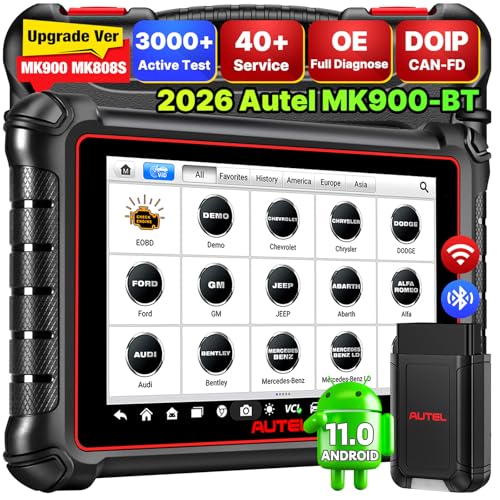
- 💯【Conta.ct us for Support Directly】If you met any...
- 🔥🔥🔥【2026 AUTEL FLAGSHIP MK900BT MK900-BT, NEW...
- 🚗【3000+ ACTIVE TESTS (50➡3000+), SAME AS MS...
- 🚗【40+ HOT SERVICES FOR 150 MAKES (28+➡40+)】Full...
- 🚗【OE ALL SYSTEM DIAGNOSE, AUTO SCAN 2.0: SCAN LICENSE...
Search NHTSA Database for Recalls
Search NHTSA Database for Vehicle Investigations
View Latest Vehicle Investigations
Search NHTSA Database for Vehicle Complaints
View Latest Vehicle Complaints
TSB/Document ID: V9323012069601_3
Replacement Service Bulletin Number:
MFR Communication Date: 2025-12-03
MFR Internal Campaign ID/Software Version:
Communication Type: Service Bulletin/Repair Instructions
NHTSA Components: ELECTRICAL SYSTEM
MFR Component System:
MFR Component Subsystem:
Previous TSB | Next TSB |
Connection offline
Technical Service Bulletin
Transaction No.: 2069601/3
93-23-01 - High-Voltage Battery Repair Hints, Tips, and Suggested Practices
Condition
Applicable Vehicles
Model(s)
Year
Eng. Code
Trans. Code
VIN Range
From
VIN Range To
ID.4
2021 – 2026
All
All
All
All
ID.Buzz
2025 – 2026
All
All
All
All
Revision Table
Instance Number
Published Date
Version Number
Reason For Update
2069601/1
2/23/2023
93-23-01
Original publication.
2069601/2
2/23/2023
93-23-01
Instance number change
only.
2069601/3
12/3/2025
93-23-01
Updates to applicable
vehicles and additional
informational content
Information for Volkswagen technicians – High-voltage battery repair hints, tips, and suggested practices.
Technical Background
The process of performing a high-voltage battery repair requires planning and strategy to synchronize all of
the necessary resources in an efficient manner.
While it is not possible to foresee every situation and circumstance which may be encountered, this bulletin
presents various hints, tips, and suggestions, which are presented only as an aid for Volkswagen technicians
who have already completed high voltage expert (HVE) and all prerequisite training courses.
Note:
This bulletin is a reference only, and shall not be considered to supersede or replace any published repair
manual procedures, ODIS-based instructions, Guided Fault Finding conclusions, or other technical bulletins.
Production Solution
Not applicable.
Service
Planning and Preparation
•
Prevent open-battery idle-time – Check that all necessary parts were ordered and received in good
condition, with all necessary tools and personal protective equipment (PPE) ready and the scissor-lift
table completely functional, before removing or opening the high-voltage battery.
•
Shortcuts – Avoid the use of “cheat sheets” or saved lists of parts or repair steps based on prior
repairs. Delays arise when part numbers have changed, or if incompatible parts are ordered in
error. The exact parts required must be determined for each vehicle by referencing the repair manual
to determine single-use parts, and the ETKA parts catalog to order the correct parts.
•
Cleanliness – Ensure a clean work area is available, and plan a location where the removed top cover
can be set aside and protected after removal (for battery housing versions with a potentially reusable
top cover). The blue sealant used on the top cover remains tacky. If it becomes dirty or contaminated
by other substances, then it must be cleaned off before application of additional sealant.
•
Lift suitability – Ensure that the lift has suitable weight capacity and clearance for positioning the
scissor-lift table, lowering the battery from the vehicle, and rolling it to the work location. Check that
the lift arms and pads which contact the vehicle can accommodate battery removal and installation
according to the repair manual. – see “High-Voltage Battery 1 AX2, Removing and Installing”
•
Moving vehicle with battery removed – If circumstances require moving the vehicle off the lift while the
high-voltage battery is removed, then multiple people must work together to push the vehicle in a
careful and controlled manner, and no person may enter the vehicle while the high-voltage battery is
removed. – see “High-Voltage Battery 1 AX2, Removing and Installing”
•
MEB battery repair videos – Several short training videos about various MEB battery repair procedures
are available for reference and may be found online at VW Hub > Academy > VW Cup > Training
Library. To locate these videos, search “MEB Battery Repair” from the search box.
Noteworthy Repair Manual Content Updates
The repair manual may be updated at any time. Always review all repair manual procedures before starting a
battery repair and follow them step-by-step.
Training materials are a useful reference for understanding repair concepts, but must never be used as a
substitute for current repair manual procedures.
Noteworthy changes between 2021 ID.4 launch and original 2023 publication of this bulletin:
•
Use the pipe brush VAS 294 029 or equivalent to remove old sealant from the M24 screw threads in
the housing and then vacuum the debris – see “High-Voltage Battery 1 AX2, Opening”
•
The original blue sealant need only be removed from the top cover if it is contaminated with dirt or
other substances – see “Battery Housing Upper Section, Checking for Re-Use”
•
Additional blue sealant is then applied over top of clean and uncontaminated original sealant on the
top cover – see “High-Voltage Battery 1 AX2, Sealing”
•
The leak test of the housing is done in-car before removal and after reinstallation instead of on the
removed battery – see “High-Voltage Battery 1 AX2, Removing and Installing”
•
The leak test is performed and documented with ODIS, according to the GFF test to check the housing
with vacuum instead of pressure – see “High-Voltage Battery 1 AX2 Leak Test”
•
In the steps for top cover removal, wearing arc-flash and voltage protective apparel (PPE) appears
after screw and bolt removal – see “High-Voltage Battery 1 AX2, Opening”
•
Always confirm no potential short circuit exists by measuring voltage with VAS6762/45 tester before
installing the last HV connector between SX8 and J991 – see “Circuit, Disconnecting”
Noteworthy changes after the original 2023 publication of this technical bulletin:
•
New housing versions were introduced starting in MY24 and the headings and illustrations must be
used to identify the battery version being repaired – see “Overview - Removed High-Voltage Battery”
•
The top cover in earlier housing versions (i.e., Version 0 and Version 1 in the repair manual) generally
remain reusable – see “Battery Housing Upper Section, Checking for Re-Use”
•
The top cover in later housing versions (i.e., Version 1.1 and Version 2 in the repair manual) may be a
single-use part if noted as such – see “Overview - Removed High-Voltage Battery”
•
Additional small covers over screws in later housing versions (i.e., indicated as Version 1.1 and
Version 2 in the repair manual) are single-use – see “Overview - Removed High-Voltage Battery”
•
In some housing versions, repair of M5 screw threads for securing the inner portion of the top cover is
possible – see “High-Voltage Battery Threads, Servicing, Battery Housing Upper Section
•
In some housing versions, repair of M8 screw threads for securing cell modules into housing is
possible – see “High-Voltage Battery Threads, Servicing, Battery Module”
•
In case of a failed leak test of an installed battery using vacuum, tightness of the lower hollow screws
(aka banjo bolts) should be checked – see “High-Voltage Battery Leak Detection”
•
Further diagnosis in case of a failed leak test uses pressure instead of vacuum and a leak-detection
spray (e.g., soapy water) to identify leak location – see “High-Voltage Battery Leak Detection”
•
When necessary, use compressed shop air to flush the HV battery with the top cover lifted from the
lower housing at the end opposite the connection board – see “High-Voltage Battery 1 AX2, Flushing”
Cell Balancing – Cell Module Replacement
•
Never install any cell module without first ensuring it is properly and precisely balanced to match the
cells in the battery which are not being replaced. It is never appropriate to install cell modules which
are not properly balanced.
•
Balancing time – The amount of balancing time varies in proportion to the difference between the cell
voltages in the battery pack and those of the new cell module. If the problem which requires a cell
module to be replaced does not render the high-voltage battery inoperable, then it is advantageous to
charge or discharge the high-voltage battery in the vehicle before removing it, so that the state of
charge (SOC) of the battery pack is closer to the SOC of the new module (typically 25-30%).
•
Charging rate – The VAS 6910 provides 5X higher current charging (50A) than discharging
(10A). Therefore, it takes less time to charge a new cell module to the target voltage of the rest of the
pack than to discharge it by a comparable amount when using the VAS 6910 module balancer.
•
Voltage precision – Determine the target voltage for the VAS 6910 module balancer, balance the new
cell module, and install it shortly thereafter. Consider that if the problem which requires a cell module to
be replaced does not render the high-voltage battery inoperable, then the cell voltages in the battery
pack may change (such as through operation of heat or air conditioning, 12V consumers, or
autonomous recharging of the 12V battery from the high-voltage battery).
•
Balancer software – The VAS 6910 operates from standalone software (i.e., “VAS DSS”) and is not
currently integrated with ODIS. Ensure the most recent and up-to-date software package for the VAS
6910 module balancer is used, which includes the addition of any new part numbers for recently
introduced cell modules which can be balanced using the VAS 6910. The software is now available for
download from VW Hub > Elsa2go > Infomedia.
•
The updated version VAS 6910A module balancer may be used instead of the original VAS 6910. The
updated version offers increased performance and integration with ODIS, but is not currently required
for cell modules that are within the capabilities of the VAS 6910 module balancer (under 60 Volts).
•
Check whether any additional technical bulletins apply to cell module replacement in the vehicle being
repaired, including but not limited to build-status documentation described in Technical Bulletin
2074770/*: 93-24-06 - Service Information, Important Step for Replacing HV Battery Cell Modules.
Top Cover – Large Hollow Screws
•
Use hand tools only! – Power tools increase the likelihood of aluminum housing thread damage.
•
Large hollow screw removal – The large M24 threads are coated with an encapsulated
sealant. Remove the hollow screws with care. If resistance is felt, work the screw back and forth
slowly.
•
Large hollow screw thread cleaning – In addition to brushing out the old sealant with the pipe brush
VAS 294 029 or equivalent, a removed old screw in good condition may be used as a cleaning
aid. The large tap VAS 274013 should only be used with extreme care if absolutely necessary.
•
Hollow screw thread damage – The cosmetic appearance of the threads is not critical. However, if the
specified torque cannot be achieved when the new hollow screws are fully installed, then the complete
lower housing must be replaced – no approved repair exists!
•
Hollow screw installation – If the screw stops turning and torque increases before the shoulder of the
screw is seated against the top cover, stop and check threads before reattempting installation.
•
Inspect new hollow screws – Check threads for damage and do not use screws which have any
significant gouges or nicks in the thread that could cause housing thread damage.
Top Cover – Small Screws (Outer Perimeter)
•
Use hand tools only! – Power tools increase the likelihood of aluminum housing thread damage.
•
A 1/4-inch drive speeder handle with the appropriate Torx bit is a good option, which allows quicker
removal than a ratchet without increasing risk of damage.
•
Perimeter screws on cover (pointed tip flow-drill screws) – Remove with care to avoid
damage. Screws are typically replaced with all new screws of the original type, according to the repair
manual.
•
Repair with over-size screws is possible if thread damage occurs. Refer to repair manual, and obtain
ETKA bulletin 9-174 from the parts department for reference.
Top Cover – Small Screws (Inner)
•
•
Use hand tools only! – Power tools increase the likelihood of aluminum housing thread damage.
A 1/4-inch drive speeder handle with the appropriate Torx bit is a good option, which allows quicker
removal than a ratchet without increasing risk of damage.
•
Central screws on cover (machine screws with wax) – Remove with care to avoid damage. Screws are
typically replaced with all new screws of the original type, according to the repair manual.
•
Repair of damaged M5 threads is permissible if repair instructions are present in the repair manual and
thread inserts are listed in the ETKA catalog for the HV battery housing version being repaired.
ODIS Service & Guided Fault Finding
•
Obtain a readout of all measured value blocks (not just cell voltages) from the Battery Regulation
Control Module -J840- (diagnostic address 008C) before removing and opening the battery. Save the
log locally and send it to GFF Paperless. This is important documentation to have available for
reference if needed and is much easier to obtain before the battery repair has started.
•
From the measured value blocks, record the “ASSY part number” (battery assembly part number) and
“Serial number of H-V / hybrid battery” starting with “288” for reference. These may be requested
within various GFF test plans. Every HV battery has an assembly part number and serial number
which is stored in memory and printed on the identification label or etched on the battery housing.
•
Certain DTCs including voltage-sensing errors and contactor stuck-open/closed faults remain static
even if the condition is intermittent and may hold the battery in non-operational shutdown-mode. Such
DTCs cannot be erased by the GFF test “008C – Read/Erase DTC Memory” or upon exiting GFF
diagnosis and should be handled using the corresponding GFF test plan. If such DTCs remain after a
battery repair has already been completed, then the suitable GFF test plan “008C – Controller
Configuration” or “008C – Replace control unit” can be effective for erasing these DTCs.
•
ODIS may be used with the battery removed from the vehicle to validate that no unexpected faults or
abnormal measured block values remain, before sealing the battery top cover and reinstalling the
battery into the vehicle. Communication with the Battery Regulation Control Module -J840- is possible
using either the VAS 671007 Extension Cables for High Voltage Battery or the VAS 5581A High
Voltage Diagnostics Box. When using the VAS 5581A High Voltage Diagnostics Box to communicate
with a standalone HV battery, select “GW” (Gateway) mode and start a new GFF session from
“Component Diagnosis” with manual VIN entry.
Battery Control Unit Replacement (J840+SX7+SX8 Repair Kit)
•
Note the software version of the Battery Regulation Control Module -J840- from the identification of
diagnostic address 008C in ODIS before starting the battery repair. The new control unit being installed
must have the same software version as that being removed, unless a technical bulletin or other
published information states to use a different version.
•
The Battery Regulation Control Module -J840-, High-Voltage Battery Control Module, Negative
Terminal -SX7-, and High-Voltage Battery Control Module, Positive Terminal -SX8- are a matched set
and must always be removed and replaced together (sold as a repair kit for service).
•
The valid battery assembly part number and serial number are printed on the identification label or
etched onto the housing of each high-voltage battery. If a repaired battery has already been
reinstalled, these may be found in the measured value blocks read out in a prior GFF log from the start
of diagnosis.
•
When replacing the Battery Regulation Control Module -J840- always run the necessary GFF test
“008C - Control Module, Replacing” before removal of the old control unit. If this is not done, then the
battery assembly part number and serial number will not be copied from the old control unit to the new
one and must thereafter be entered manually.
•
If necessary, the valid battery assembly part number and serial number can be entered manually. If
manual entry cannot be performed successfully within the GFF test “008C - Control Module,
Replacing” then it is possible to enter the correct values to “ASSY part number” and “Serial number of
H-V / hybrid battery” manually from Self Diagnosis (OBD) > Diagnostic address 008C > Adaptations.
•
Software configuration with a valid target data container (ZDC) in the new Battery Regulation Control
Module -J840- is necessary for operation of the battery and requires a valid HV battery assembly part
number and serial number. The software configuration can be performed by diagnostic address 008C if
it was not completed during “008C – Control Module, Replacing.” Without valid software configuration,
the measured values may display alternating blocks of valid/invalid cell voltages and DTCs such as
“data set missing” and “data record invalid” will be present.
Cell Module Control Unit Replacement (J1208, J1212, J1216, J1429, etc.)
•
Note the software version of each Battery Module Control Module (CMCe) -J1208-, -J1212-, -J1216-,
and if applicable -J1429- from the sub-bus identification of each under diagnostic address 008C before
starting the battery repair. The new control unit being installed must have the same software version as
that being removed, unless a technical bulletin or other published information states to use a different
version.
•
If one more Battery Module Control Module (CMCe) -J1208-, -J1212-, -J1216-, or -J1429- is installed
that has software incompatible with the Battery Regulation Control Module -J840-, then “software
incompatibility” DTCs will be present in diagnostic address 008C.
•
The GFF test plan “008C – Controller configuration” (module addressing) must be used after
replacement of a CMCe control unit. The GFF procedure includes a bus-sleep step. Without a proper
bus-sleep at the step where it is indicated, the configuration will not be saved. Incomplete configuration
will result in multiple invalid cell voltage readings and the HV battery will not operate.
Accuracy of Service Parts Selection
•
Batteries assembled in different plants can look nearly identical in physical appearance, yet have
different properties and performance characteristics. This includes not only the functional electrical
parts, but also single-use parts such as screws, bolts, gaskets, etc.
•
Use only the specified parts for the specific battery being repaired, according to the ETKA
catalog. Nothing which is designed for one battery may be interchanged with another battery unless it
is a common part number for both, according to the ETKA parts catalog.
•
It is never appropriate to judge compatibility of cell modules on the basis of physical characteristics,
voltage, or connector fitment. Only the part number may be used to determine a suitable replacement
part, according to the ETKA parts catalog.
•
Never install a new cell module from one supplier into a battery pack containing cell modules from a
different supplier. Cell modules from different suppliers may contain cells with different chemistries or
different series-parallel configurations that are not interchangeable.
Warranty
Information only.
Required Parts and Tools
Not applicable.
Additional Information
All part and service references provided in this Technical Bulletin are subject to change and/or removal.
Always check with your Parts Dept. and Repair Manuals for the latest information.
© 2025 Volkswagen Group of America, Inc. All rights reserved. Information contained in this document is
based on the latest information available at the time of printing and is subject to the copyright and other
intellectual property rights of Volkswagen Group of America, Inc., its affiliated companies and its licensors.
All rights are reserved to make changes at any time without notice. No part of this document may be
reproduced, stored in a retrieval system, or transmitted in any form or by any means, electronic, mechanical,
photocopying, recording, or otherwise, nor may these materials be modified or reposted to other sites,
without the prior expressed written permission of the publisher.

- CEL Doctor: The ANCEL AD310 is one of the best-selling OBD II scanners on the market and is recommended by Scotty Kilmer, a YouTuber and auto mechanic. It can easily determine the cause of the check engine light coming on. After repairing the vehicle's problems, it can quickly read and clear diagnostic trouble codes of emission system, read live data & hard memory data, view freeze frame, I/M monitor readiness and collect vehicle information.
- Sturdy and Compact: Equipped with a 2.5 foot cable made of very thick, flexible insulation. It is important to have a sturdy scanner as it can easily fall to the ground when working in a car. The AD310 OBD2 scanner is a well-constructed mechanic tool with a sleek design. It weighs 12 ounces and measures 8.9 x 6.9 x 1.4 inches. Thanks to its compact design and light weight, transporting the device is not a problem. The buttons are clearly labelled and the screen is large and displays results clearly.
- Accurate Fast and Easy to Use: The AD310 scanner can help you or your mechanic understand if your car is in good condition, provides exceptionally accurate and fast results, reads and clears engine trouble emission codes in seconds after you fixed the problem. This device will let you know immediately and fix the problem right away without any car knowledge. No need for batteries or a charger, get power directly from the OBDII Data Link Connector in your vehicle.
- OBDII Protocols and Car Compatibility: Many cheap scan tools do not really support all OBD2 protocols. AD310 scanner as it can support all OBDII protocols such as KWP2000, J1850 VPW, ISO9141, J1850 PWM and CAN. This device also has extensive vehicle compatibility with 1996 US-based, 2000 EU-based and Asian cars, light trucks, SUVs, as well as newer OBD2 and CAN vehicles both domestic and foreign. Pls confirm with our customer service whether it is compatible with your vehicle before purchasing.
- Home Necessity and Worthy to Own: This is an excellent code reader to travel or home with as it weighs less and it is compact in design. You can easily slide it in your backpack as you head to the garage, or put it on the dashboard, this will be a great fit for you. The AD310 is not only portable, but also accurate and fast in performance. Moreover, it covers various car brands and is suitable for people who just need a code reader to check their car.

- Multi-Functions - Practical Multi-Functions OBD2 code reader features built-in OBD2 DTC lookup library, which help you to determine the cause of the engine light, read code, erase code, view freeze frame, I/M ready, vehicle information, data flow, real-time curve, get vehicle speed information, calculate load value, engine coolant temperature, get engine speed.
- Wide Capability - Supports 9 protocols compatible with most 1996 US-Based, 2000 EU-Based and Asian cars, and newer OBD II & CAN domestic or import vehicles. Supports 6 languages - English,German, Dutch, Spanish, French, Italian.
- 2.8" LCD Display - Designed with a clear display 2.8" Large LCD screen - white backlight and contrast adjustment. No need any battery or charger, OBD reader gets the power directly from your vehicle through the OBDII Data Link Connector.
- Compact Design - Car diagnostic scanner is equipped with a 2.5 feet long cable and made of a very thick flexible insulator.There are 6 buttons on OBD2 Scanner:scroll up/down,enter/exit and buttons that quick query VIN vehicle number& the DTC fault code.
- ABS / Airbag codes NOT Supported - It is able to read and clear check engine information which is part of OBDII system, but it cannot work with non-OBDII systems, including ABS / Airbag / Oil Service Light, etc.

- 【Your Personal CEL Doctor – Read & Clear Engine Codes】The NT301 OBD2 scanner lets you read diagnostic trouble codes (DTCs), check em-issions readiness, turn off your Check Engine Light (CEL) or MIL, reset monitors, and view live data streams. It retrieves your vehicle's VIN instantly. Like all standard OBD2 scanners, it clears codes only after repairs are completed—if the issue persists, the code will return. Designed for DIYers who want to understand what’s really going on under the hood.
- 【Easy Code Reading – Just Plug & Play】Simply plug into the OBD2 port, turn the ignition to “ON” (engine off), and select the correct menu: Select OBDII-> Wait for seconds-> Select Read codes. For accurate results, ensure your vehicle is compatible and the OBD2 port is free from damage or wiring issues. No batteries needed— powered directly by your car.
- 【Live Data Graphing & Accuracy for Most OBD2 Vehicles】View and log live sensor data in graph form—monitor oxygen sensors, fuel trims, coolant temp, RPM, and more. Spot trends and suspicious values in real time. Compatible with most 1996+ gasoline cars, light trucks, and SUVs sold in the U.S., as well as many 2000+ European and Asian models. Also works on 12V diesel vehicles equipped with OBD2.
- 【S-mog Check Helper – Know Your Readiness Status at a Glance】With dedicated I/M readiness hotkeys and a simple Red-Yellow-Green LED indicator, you’ll instantly know if your vehicle is ready for em-issions testing. Built-in speaker provides audio feedback. No guesswork—just confidence before you head to the test center.
- 【A Must-Have Tool for Every Home Mechanic】Compact, rugged, and ready to use right out of the box. The 2.8” color screen is easy to read, even in daylight. No charging or setup required—just plug into the 16-pin DLC and start diagnosing. Recommended by professional mechanics on YouTube and trusted by DIYers worldwide.
Last update on 2026-03-27 / Affiliate links / Images from Amazon Product Advertising API
This product presentation was made with AAWP plugin.